
Chattooga County's Multi-Day Arrest Log
The working blotter is a string of Chattooga County Jail Media Reports distributed by Coosa Valley News. The sheriff's office prepares each PDF. The news outlet hosts and indexes it. So it is a media-hosted copy of a jail report, not a live sheriff database. No fixed 72-hour or seven-day interface exists online.
A March 2, 2026 sample ran at 9:04 a.m. and covered February 27 through March 2. Four people were in custody. Four more were booked and released. That Friday-to-Monday span is exactly why a multi-day report earns its keep after a weekend. One sample proves neither that every report uses four days nor that each day in the range held an arrest.
Read Chattooga Arrest Reports by Date
Start with the Coosa Valley News arrest-report archive and work backward by report date. A post date is only the index point. The report's own run date and From/To range control what it covers. Ignore those dates and you can misread the window. The broader Chattooga News category is a second route.
- Open the newest post and confirm that its PDF names Chattooga County.
- Read the report run time and the From and To dates before scanning names.
- Check both “currently booked” and “booked and released” sections.
- Compare arrest time with process time and note the arresting agency.
- Move to the prior report for an uncovered day, then request the record if the archive has a gap.
For something that happened today, use the Arrests Last 24 Hours window instead. The blotter is a catch-up tool. It covers weekend gaps and leaves an archive trail.
Fields in Chattooga Arrest Entries
No booking photos appear in current samples. Entries are text and tables. Still, the fields let a reader compare similar names, separate enforcement from jail processing, identify the arresting agency, and skip any claim about the court outcome.
| Report field | How to read it |
|---|---|
| Inmate number and name | Jail identifier and recorded identity |
| Race and sex | Descriptors that may help distinguish a match |
| Process date and time | When the jail recorded intake activity |
| Arresting agency and officer | Who made or presented the arrest |
| Arrest date and time | Recorded enforcement event, which can differ from process time |
| Charge | Charge listed at booking |
| Property bond and cash bond | Bond information available when the report ran |
Read the section labels as closely as the fields. "Currently booked" reflects custody at report time. "Booked and released" marks an intake followed by release within the range. For anything after that, the Chattooga State or Superior court record is the place to look.
Weekend Chattooga Arrest Report Pattern
The March 2 sample sets a clear pattern. A Monday morning report gathered Friday through Monday activity instead of a daily file. The Coosa Valley archives show repeated weekday posts and wider ranges around some gaps. No official schedule exists. No guaranteed publication time either. So treat the pattern as observational, not promised.
A weekend report with more names is not evidence of an arrest surge. Compare date range, not list length. Someone arrested late in the range may still be processing when the file runs, while a person booked and released earlier appears only in the released section. If the range still misses your date, check the roster, call the sheriff, and request the specific record.
Older Chattooga Arrest Log Records
The visible archive lasts only as long as the news publisher keeps posts indexed. The sheriff has promised no set online depth. Georgia's local-government schedule is stricter. Daily incarceration lists carry a one-year minimum, while jail booking records and inmate case files last ten years after release. Jail registers stay ten years after the last entry. Those periods govern retention, not free web access.
For a missing or old date, send the sheriff's written open-records form. Include the person's name, the approximate arrest date, the arresting agency, and the exact item sought. The first 15 minutes of search are free. After that, administrative and copy or mailing costs can apply, so ask for an estimate. If the office says a record was destroyed, ask which retention authority it used.
Historical material needs a date label. An older Lookout Mountain Judicial Circuit "24 Hour" PDF used detention-placement, warrant, charge, and court fields that may not match today's format. Likewise, old media items may show photographs. The current sheriff site says no pictures are published.
Chattooga Arrest News Is Secondary
Three secondary channels play different archive roles. Coosa Valley News distributes the current Jail Media Reports. The Georgia Gazette keeps an independent Chattooga crime archive and says it obtains public records. AllOnGeorgia has published weekly sheriff-report material, though its presentation predates the current 2026 daily samples. None of them is the jail custodian. No publisher controls the official court outcome. The Chattooga News archive shows the local cadence and broader report ranges.

The Georgia Gazette Chattooga archive is another dated source. It helps locate dates, but each linked PDF must be read for its own coverage range.
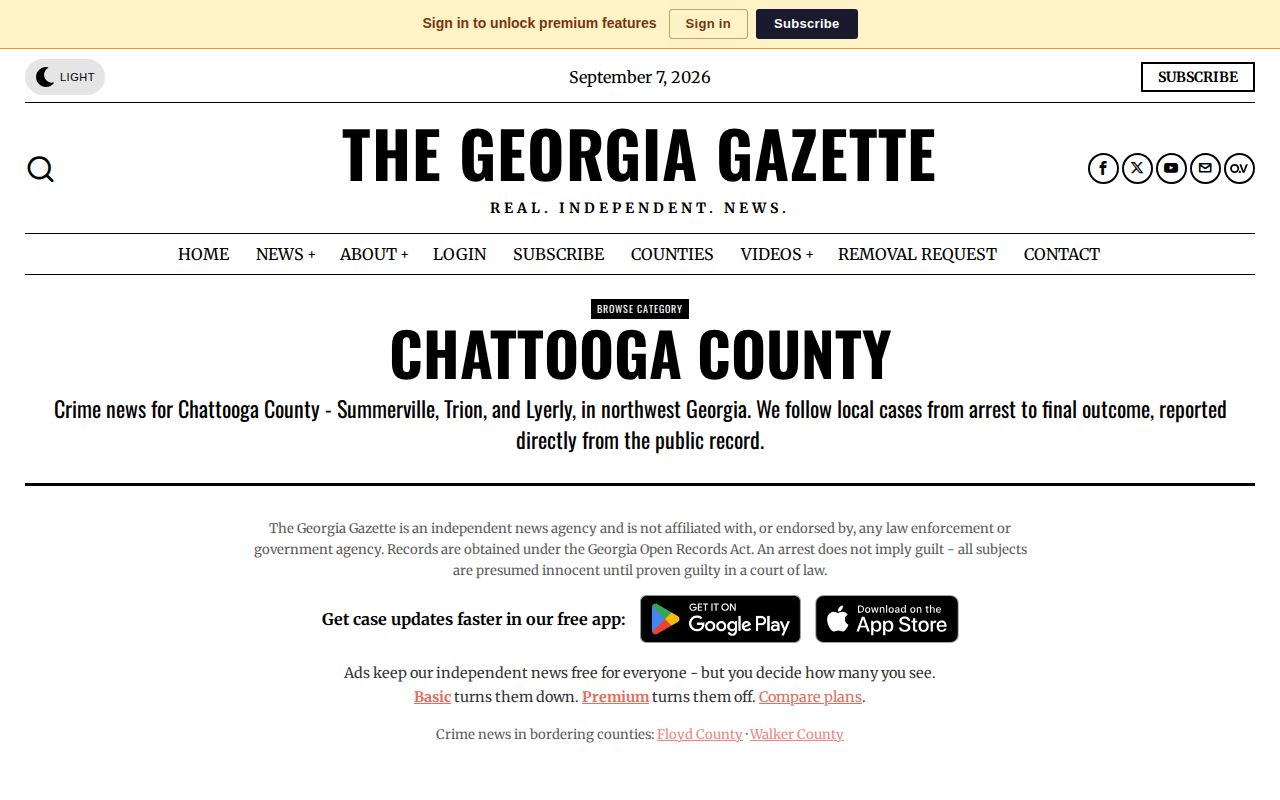
These pages can outlast a roster entry. They can also go stale, so verify identity, charges, custody, and disposition through official records.
Photos Changed Across Chattooga Reports
Chattooga County's sheriff site publishes no booking photos. Current reports run text-only. Older reports and news artifacts from past years carried images. So the format clearly changed. What the record does not show is when. It gives no reason either. Don't assume a current booking photo exists just because an old article included one. Match any saved image to its own report, and keep that date with every copy you save.
When sources conflict, trust the office that created the fact. Ask the jail about booking and custody. Ask the arresting agency about its incident report. The clerk answers for the docket. Note the date you checked, since rosters and publisher pages change. Compare inmate number, arrest date, agency, and case number before calling an archive entry a match. Never merge an old photo, current jail status, and a later charge into one undated story. If an official record is corrected or restricted, send proof through the publisher's free correction process. That decision does not amend the sheriff or court record.
Archive dates also expose gaps. Record each report's full range. Compare it with the next and prior reports. If neither covers your date, ask the sheriff for the named jail record. Georgia's schedule may let the agency keep an older file in custody. It cannot force a news publisher to keep a PDF online. Search results alone prove nothing. Open the source. Confirm its date, county, and report range. Check it again before you rely on it.
Request an older blotter by document name, not by person. Give the Jail Media Report date range, the approximate arrest date, and the inmate number when known. Name the arresting agency too. Narrow detail helps the custodian search efficiently. It also lets you weigh any cost estimate against the scope. If a report is partly protected, ask whether nonexempt fields can come out in a redacted copy. Juvenile data, victim facts, medical details, and some pending investigative material may be limited. A withheld name only shows what the custodian can release at that stage. Keep custody and court research separate. The blotter shows what the jail recorded during its range. The docket shows whether prosecutors filed the charge. Both can be accurate while answering different questions.
Keep the original report date with every saved copy of a Chattooga County arrest report. Verify any later change through the sheriff and the court.